Showing posts with label culinary experiences. Show all posts

Friday, November 18, 2011

Saemangeum Sushi: A Different Creature for Each Eater

Our last lunch together was at Saemangeum Sushi Restaurant in Gunsan...and I would say the most ornate of all the meals. It started out downstairs in a fresh, bright/bold blue open room housing tanks of various fish, crabs, and sea squirts. Little red and white plastic flags representing different countries hung from the ceiling. It felt quite surreal, as if we had walked up a staircase that stopped suddenly in the clouds, and here was this room. We turned the corner and found the actual staircase which lead us to the restaurant. A couple banners with the logos and photos of KBS and another tv station decorated the wall, which meant good things.

We sat down on cushions on the floor of one of the few private rooms and marveled at the ocean view and the bright, sunny light coming in from windows. A perfect lunch atmosphere.

We were served first a large square platter of various sushi atop mounds of glass noodles and garnished with bright little yellow flowers with red tips, bunches of parsley and wedges of lemon. The only fish I could identify were sea squirt (which I'd been wanting to try for months!), salmon, and prawn, but there were four other varieties as well.

The sea squirt is that little orange-red, spiky-looking sea-anemone-like creature all over markets. I have seen women slicing them open at markets to reveal an inner orange meat similar to the meat inside a mussel. I was always curious but wasn't sure how to cook them. So at the restaurant they had sliced the 'squirt' open so that its outer skin fell in a blanket underneath the separate-cut pieces of raw flesh. The taste was bitter and I didn't want to take more than one as there were only a few pieces there to go around, so I never ended up finding the appropriate sauce to dip them in, if there was one. I think they could have been good had I matched them with a recommended dip, though. I always want to find a way to make an unappealing taste appealing, because I like the idea that everything can taste good, that there IS a way to make everything taste good. But maybe that is just too lofty a thought.

Next they brought out the platter of fish skin gelatin: grey gelatinous squares of pure fat from the skin of a particular fish. I was intrigued with this idea at first and wanted to try it in its pure form although they recommended it be dipped in sauce. They were right. I tried it again dipped in a soy paste. Better, but still not something I could eat more than two squares of. It literally melted into oil in my mouth and glided down my throat with no effort. I asked the waiter via translation about this dish, and he said 'if you eat this you will never need botox.' Ha.
Fish skin gelatin

Then came the side dishes: kimchi, radish marinated in chili sauce, pickled garlic cloves, cooked zucchini, lightly cooked bean sprouts, and sweetly marinated cold, shredded jellyfish salad ('hepari').
Then the raw oysters in a small black and sea green ceramic bowl nestled in glass noodles on a matching square dish, with a wedge of lemon on the side. Yum!

And finally, a delightful, savory, red-sauced medley of thin tentacle mushrooms, spring onions, garlic, various spices, and the most amazingly tender fish I've ever eaten! As opposed to many other restaurants I've been to in the west, where they skimp on fish, this stew was packed with both short and long fillets of fish. I was already quite full, but I had a difficult time putting my spoon down, as most everyone was finished by this point, and there was still fish left in the pot!

Fantastic Fish Stew!
What I liked most about this restaurant was that we got to try a few different fish both in their raw and cooked forms. It was satisfying to be able to taste them in both styles. Different flavors come out, different nutritional properties are available depending on whether it's cooked or not, just as it is with any food.


The beautiful sushi platter (orange creature above is the sea squirt!)


Flat-fish, simple and delicious in flavor - no need for much flavoring

The lunch spread

Flat-fish cooked in a savory chili-pepper sauce

Oysters! Atop glass noodles that apparently weren't for eating.

Saemangeum Sushi Restaurant
군산시 비응도동 62-12번지
063-464-1000
-Anina

Nungil Village: An Unsung Hero to Makeoli Drinkers Everywhere

The Happy Bears went to Nungil Village to make Makeoli. We did it for our health, taste, enjoyment, and self-knowledge. 

Makeoli has the alcohol percentage above a standard lager( 6%) with the sweetness of a soft drink and milky texture with an acidic kick. Some even are carbonated to have the fizzyness of soda. We love its taste.

Makeoli is particularly special to me. It's an example of what can be called healthy alcohol. When traditionally made, its taste is amazing and it contains many beneficial bacteria and yeast. Just like how kimchi, and yogurt have symbiotic healthy lactobacilli bacteria for our gastrointestinal track, so does Makeoli. However,  Makeoli also has the added benefit of yeast.

Most commercial Makeoli is pasteurized and artificially sweetened with Aspartame, which is a known neurotoxin. Fortunately, there are people who are bringing back the old style of making alcohol, such as  commercial brewers or individuals and groups who are doing it themselves for themselves or their families. They are heros to us for doing something that costs a little more but is safe and healthy for us.

Nungil Village is one of those heros.

Nungil Makeoli is not a brewer of commercial makeoli, but a school to teach people how to make nutritious and delicious Makeoli, food, and how to grow food. 

So we went to learn.

We were not disapointed.

The Happy Bear drove to the Nungil Restaurant and entered the school.

Our teacher, had already the materials laid out before we arrived. On stepping into the room, there was a container of yeast in liquid, nuruk(누룩), a cake wheat, barley, and rice, which has wild gathered lactobacilli bacteria and yeast from the air that accumulated on the cake. Both rested on a tablecloth spread across a long folding table.

I'm a homebrewer so while my Korean is spotty I'm familiar with the brewing process and I felt comfortable as our translator translated the teachers words to us.

Our teacher brought out the steamed rice.

Our teacher told us what to do and we listened.

"The rice must be steamed in a steamer and not a rice cooker so it does not lose sugar. It must be slightly hard."

We spread the rice out and allowed it too cool. When the rice was the temperature of our hand, we would add the nuruk.

"If too hot, the bacteria will die," the teacher said.

He then showed us the nuruk which sat in a metal bowl shown in the picture on the right.  Nuruk is made traditionally by wrapping a wet cake of wheat, barley, and rice in a husk and putting it in a barn or someplace else to gather the wild yeasts and bacteria.

We mixed the nuruk into the rice. The nuruk will break the rice into simple sugars for the yeast to eat and produce the alcohol. Without the nuruk, the complex sugars cannot be broken down into simpler sugars for the yeast to eat and make alcohol.


Then the teacher showed us the yeast, which was simply Fleichers Bread yeast prepared in warm water with some sugar. The yeast is not necessary as it is airborn, everywhere on Earth, but it shortens the process of Makeoli making from 1 and half weeks to four days.


A texture of yeast.

We added water over the rice to just over the rice and then sealed the pot with a lid with an air gauge attached. We carried the pot to a stone cellar with thick stone walls which keeps the temperature inside cool and keeps the temperature from fluctuating extremely.

The stabilization is important according to our teacher to keep the Makeoli ph balance between base and acid. If too much of one or the other, then the wonderful flavor will be bad.

After four days water, the yeasts outcompete and kill all the unhealthy bacteria and the healthy bacteria remain.

The value of alcohol as a safe source of water was appreciated by European colonists of America. The Pilgrims refused to drink water for fear of diseases remembered from plagues in the past  and drank beer instead because they knew that it would keep them healthy.

After the four days, water is added at a 3:1, water:rice ratio and the Makeoli is aged for a week so the flavors mingle and the taste improves.


The Happy Bears were lucky to get to drink the Makeoli available. Before drinking it our teacher reminded us to not drink commercial makeoli with Aspartame in it.

The Makeoli he served was special because it was made from the extract of Jerusalem Artichoke leaves (돼지 감자 or pig potato). It has many medicinal effects some of which are pain relief, antioxidization, and stomach soothing.

The taste was amazing so we happily drank two or three glasses before we were went on to our next adventure.

Jerusalem Artichoke Roots


Jerusalem Artichoke Makeoli


-Greg

NungGil Makeoli
JinAhn Nungil MaEul(Village)
JunBok Jinahn-Goon DongHyang-Myun NunGumL-Lee Nungil MaEul


Wednesday, November 16, 2011

The Happy Bears Vist A Farm and Restaurant that Does it Organic, from Scratch and Delicious

The Happy Bears went to Harong restaurant to try Hanjeongsik, which is a Korean traditional spread of banchana, rice and meat. It was to royal cuisine in the most peasant way making simple food using what is local and prepared on the farm that they own as well.  All of prepared with a high respect for food. It was a perfect example of farm to table. Everything to the rice sugar was made for on the farm or paid for at a premium price. That oil is Rice Bran Oil. It's really expensive and is of fantastic quality.  And all of it was delicious.


The exterior was beautiful and so was the interior but we came for the food.

We had high expectations of this place before arriving. Greg requested to Ziyeon our translator that they give us everything they had and they did till we were bursting from so much of a good thing.


So instead of feeding us one meat for our meal. They fed us two 


But first, we toured the kitchen and saw some of the ingredients they were using. The farmer and cook were preparing our meals in the warm and intimate wood laden restaurant.


The woman came over and hand fed Anina tofu which Anina said, "Tasted fresher and more earthy than any other tofu I've had before."


We all liked it a lot and the other things she showed us. It was a sign of the goodness to come. We just didn't know how good it was going to be.


The Happy Bears climbed a staircase to the second floor and sat on cushions on the floor. A few minutes later, we were served our first course of white tofu sprinkled with black sesame seeds, fresh kimchi, and the  most succulent pork laid out on a platter.
The kimchi and tofu were delicious and home made.


The pork dish is called Bossam. It is not traditional Hanjeongsik, but was presented to us to showcase good Korean organic pork. It was slowed cooked in a simmering pot with flavors of ginger, rice syrup, garlic, and soy bean paste, until the meat absorbs the flavor


It was the best pork belly these writers have tasted. Pork belly cured into bacon in America. It was so tender and so flavorsome we are still talking about it. Read more about in the amazing tastes section above.


Next came the banchan dishes (Korean 'side dishes') nestled on a woven platter.


They consisted of pickled garlic; pickled cabbage; raw white radish and a dark wild mountain green mixed with chili paste and perilla powder; sweetened pickled cucumbers; a dish on its own of kimchi; bracken fern (gosari-namul 고사리나물); and slices of chewy but slightly crunchy lotus root(yeongeun 연근)  marinated in a sweet sauce of homemade brown rice syrup, sesame oil and soy sauce.


From bottom left to right around: pickled cucumber, kimchi, gosari,  yeongeun,  and  pickled cabbage. In the center is pickled garlic. 

Gosari-namul or bracken fern is often passed by and ignored by mountain hikers in the west but it is full of vitamins, antioxidents, and LA and ALA fatty acids. It's a cheap wild food which has become a staple ingredient in bibimbap and was always around in famine times for people when they needed it. 


Andy and Greg tried to recreate the gosari namul here and they  learn a lot by what we missed. 
One might compare lotus root to what we know as water chestnut in Chinese cooking, but it is a bit heavier, chewier and starchier. And when sliced, it has a complex, geometrical design which you can see in the photo below. It's high in iron, vitamin B1 and vitamin C, and fiber.  It can be eaten as a fruit, sliced and stir-fried, or made into a tea for digestive problems. This dish we quickly devoured. 


Lotus Root  banchan which Anina and Greg were inspired to make later. 
The next dish was 'dotorimuk' which is acorn jelly. A brownish, slightly bitter flavored jelly, rich in starch, proteins, and fiber, whose flavors really come out in its sauce - drizzled in toasted sesame oil and topped with sesame seeds, its perimeter consisted of crisp green cabbage mixed with cucumber, onions, and chili paste for a fresh-from-the-ground, invigorating burst of spiciness.


The taste of the jelly was nutty with a tanin coffee body which was complimented well but it's complex sweet, sour, garlic, sesame, and ginger sauce. 


Made from wild harvested acorns the Dotorimuk sits atop a bowl of raw sliced vegetables. 


Then came individually-served black ceramic bowls containing crab legs in-shell with slices of spring onion, sesame seeds, and a thin shallow layer of fishy broth. This is called 간장 개장.


Liked by some foreigners, it's texture is a challenge for others. The results from the group were mixed. Although all liked the soft, only Greg liked the texture. If you can get past the texture of the crunchy shell the insides are succulent and delicious. 

The restaurant owners were giving us everything they had. The happy bears were bursting.  We tried our best to eat it all. Greg opted out of eating rice so I could make room for more food. Mike ate meat for the first time in 2 years to help Greg. Andy's face was red from meat consumption and Anina and Tanya did their best

Next, came a patty of tender ground beef mixed with onions and garlic and thinly drizzled with two different sauces, one sweet and dark, the other yellow and more tart, called tteokgalbi (떡갈비). The tteokgalbi aren't just beef patties. They are high quality ground meat from beef ribs. The meat is marinated for a day  in Korean flavors of ginger, garlic, rice sugar, and soy sauce, and vinegar.

The taste of tteokgalbi is like a marinated hamburger patty which is pan roasted so it retains its fat. It was delicious. 


Finally came a dish of the classic chewy, warm, slightly toasted white rice cakes with a side bowl of rice syrup to dip them in.garaetteok 가래떡; also called huin tteok, 흰떡, which means white tteok.


We all wanted to eat them all but we were too stuffed to eat all of them. But we had a job to try them, so we did. 


They were simple and delicious. Simply a plain rice cake. For those who have never had a Korean rice cake, we'll describe it. The texture is chewy. Imagine eating an inch wide chewy pasta noodle with the pleasing taste of white rice with a rice sugar on it. It was perfect simple sweet finish to the the complex flavors of food we had been eating.


And to end this perfect meal from farm to table was we a cool, light reddish colored digestive tea called Omija 오미자. It's made from the berries of schizandra chinesis. It's also known as the 'five-flavored fruit' for it encompasses the flavors of sweet, sour, salty, pungent, and bitter. The berries from schizandra chinensis have medicinal properties that are adaptogenic which means that your body can use it strenghten any system of the body, from the immune system, nervous system, lymphatic system, cardiovascular system, gastrointestinal system, to the endocrine system. It increases our bodies' ability to fight stress. In other words, it makes us stronger. It gave us a pleasing finish to our happy meal. 


Upon leaving, we walked out through a different part of the restaurant which housed private booths of hand-cut looking wooden tables, delicately hung string lights, and a piano. Such a beautiful place.

White Crane Farm Restaurant
백학농원 호롱마을
이 희 천 010-5506-9750
전북정읍시 수성동 1030-8번지
063-531-7741

-Greg and Anina


Sunday, November 13, 2011

The Paid for Chicken

SongChamBong Joseon Folk Village in  Geurong, Jeollabukdo has the most amazing tasting Baeksu (Chicken Soup) and Daktoritang (Spicy Chicken Soup). The reason they taste so amazing is because they are raised on nutritious feed and are cooked the day they are killed.

It was important for Team Happy Bear to only eat ethically raised meat and we were very happy with the living conditions for the chickens.


I had the opportunity to take responsibility for all the chickens I have eaten by killing one of the chickens we would eat for our lunch. 

I could finally put aside the guilty feeling of having other people kill things for me and I could face the reality of killing another creature. 


Before


After: Spicy Chicken Soup, a really nourishing meal.


Eating is a happy occasion that has inspired many to give thanks. Eating meat was a special occasion as hunters or farmers would kill an animal in order for their families to get the needed nutrition which was lacking in their families everyday diet. In pre-Moderrn Korea, the Mother-In-Law would slaughter and cook a chicken for her Son-In-Law when he would visit.   Eating a delicious chicken is enough itself to put happiness into an occasion.


However,  along the way to becoming a delicious meal whether from a high quality chicken from SongChamBong or from the factory farm, something died so we can live. 


There is nothing to feel bad about when taking the life of another creature so you that you may live. We live in a cycle of life in which plants and animals feed each other.


 However, that animal or plant's death should be recognized and gratitude felt. 


The only way I could really feel grateful was to kill the chicken myself. 

 I chased a chicken and caught it.  Then the farmer instructed me how to kill and I followed through. I held its feet with one foot and wings another foot and using my both hands twisted the animals neck until it broke( something which was less difficult than I thought it would be). 

Though I felt tense before taking its life, afterwards I felt a sense of relief for three reasons. I felt relieved that this creatures pain was over and that what I had done, had to be done.  Finally, I was relieved of the need to prove something to myself.

And I felt grateful. 

I prepared the chicken for cooking. I put the animal in steaming water to loosen its feathers. Then I took it out.  Mike and Anina came to me and helped me pluck it.


"How do you feel," Mike asked me.

"I feel good," I said.

"I feel good to," he said.

The farmer cut open the bird and told me what to do next and I did it. 

After gutting the chicken, we went for a walk. The chicken was taken to the restaurant to be cooked into Daktoritang(Spicy Chicken Soup). 


We arrived at the restaurant shortly afterwards and waited for our food to arrive. The Baeksu arrived 10 minutes later. Then sometime later my freshly killed chicken arrived transformed into Daktoritang.

I tasted it. 

The taste was noticeably different from the cheap chicken my mother would buy from my local supermarket as a kid.  The difference was night and day. The supermarket chicken had no flavor so my mother would smother the chicken in breadcrumbs and fry it in oil. But this SongChamBong chicken tasted amazing. It tasted as if I had never tasted chicken before. Its intensity of flavor and texture put huge smiles on my face throughout the meal with each taste.


There was another reason I was smiling. I had paid for this chicken. 


So delicious, I pasted this picture twice.


Contact information:
Song ChamBong Chosun Village
Geurung, Jeollabukdo
063-532-0054
011-734-4506


If you liked this article, then maybe you would like to watch:


Or read about Baeksu which is another Chicken soup from the same restaurant:


Tuesday, November 8, 2011

Songchambong Joseon Village chicken really makes the broth!

The chicken may not be from the Joseon dynasty but after a walk through a bland car park and you’ll be transported back in time. After a gentle climb up the hill the scent of smoke filled the air along with feelings of ‘a long time ago’.


Internally the 송참봉조선동네 (Songchambong Joseon village) restaurant Geurong, Jeollabukdo looks like a hanok traditional house but with tables and delicious foods being consumed. Externally it matches the Joseon style seen throughout the village where we slept over. On a Saturday, our lunch was a whole chicken soup(Baeksu) and a diced spicy chicken Soup (Daktoritang) still fresh from Greg’s earlier deed of chicken preparation(read about this in his upcoming entry). To accompany these two wonderful dishes many a side dishe (banchon) was served and to my delight spicy anchovies were included in the spread!

Restaurant entrance Joseon style

Inside the restaraunt

Baeksu reminded me a samgyaetang, a summer soup made with a whole baby chicken stuffed with garlic, ginseng roots, dates and a chestnut or two and simmered until tender. The Koreans believe chicken soups will revitalize their energy and fluids during the hot summers. Essentially the only difference between Samgytang and Baeksu is the chicken used in baeksu is older and larger which is great because there’s no chance you will go hungry! The taste of both are like well seasoned chicken soup. 

Baeksu: Prepared with garlic, ginseng, chestnut, dates and ready to simmer

Not only that; we all knew where the food had come from; we could see the chicken’s foraging around in the pens, we experienced how the chickens were prepared for the dish and we all ate with reassurance. 

Their healthier diet has only improved the taste of the bird. What struck me was the tenderness of the chicken considering the bird was much older than was is used in samgyaetang. The steady simmering of the ingredients over a gas stove (a common site in many Korean restaurants) created a garlic and ginseng mush that melted in my mouth. As the chicken simmered away it wasn’t long until the whole thing came apart like a terminally rusting ship exposing its hull, but at least this hull was put to good use, as we turned up the heat the bones began to add an even deeper flavour as the soup thickened and the juices flowed from spoon to tongue, to a thoroughly satisfied stomach. With flavours that would make a grown man cry, the intensity of this soup probably made it the best soup I have ever tasted.

Baeksu: The chicken falls apart as the soup simmers

Spicy Chicken Soup: Gregs legacy in his upcoming blog post. 


I once visited a fried chicken restaurant in Gyeongju, quite a common site in and around the student districts, it had the motto ‘chicken and joy’ I didn’t really see this as an appropriate motto especially for Korean fried chicken as the quality of the chicken was very poor. However the Joseon restaurant really did combine chicken with joy and purely on taste, it is the best restaurant I've been too on Happy Bear's tour of Jeollanambukdo.


-Andy 


Contact information:

Song ChamBong Chosun Village
Geurung, Jeollabukdo
063-532-0054
011-734-4506


Thursday, November 3, 2011

Jeonju's Most Famous Bimbimbap Restaurant: A Real Human Touch from the Daughter of it's Inventor

Before arriving in Korea, I knew that my orientation would be in Jeonju and one of the first things you'll find when learning about Jeonju is that it is known for the beloved Korean dish called bibimbap. At its simplest, "bibim" means mixed in Korean and "bap" means rice and without further elaboration, that is exactly what the dish is. Or it is, at least, what the dish once was.

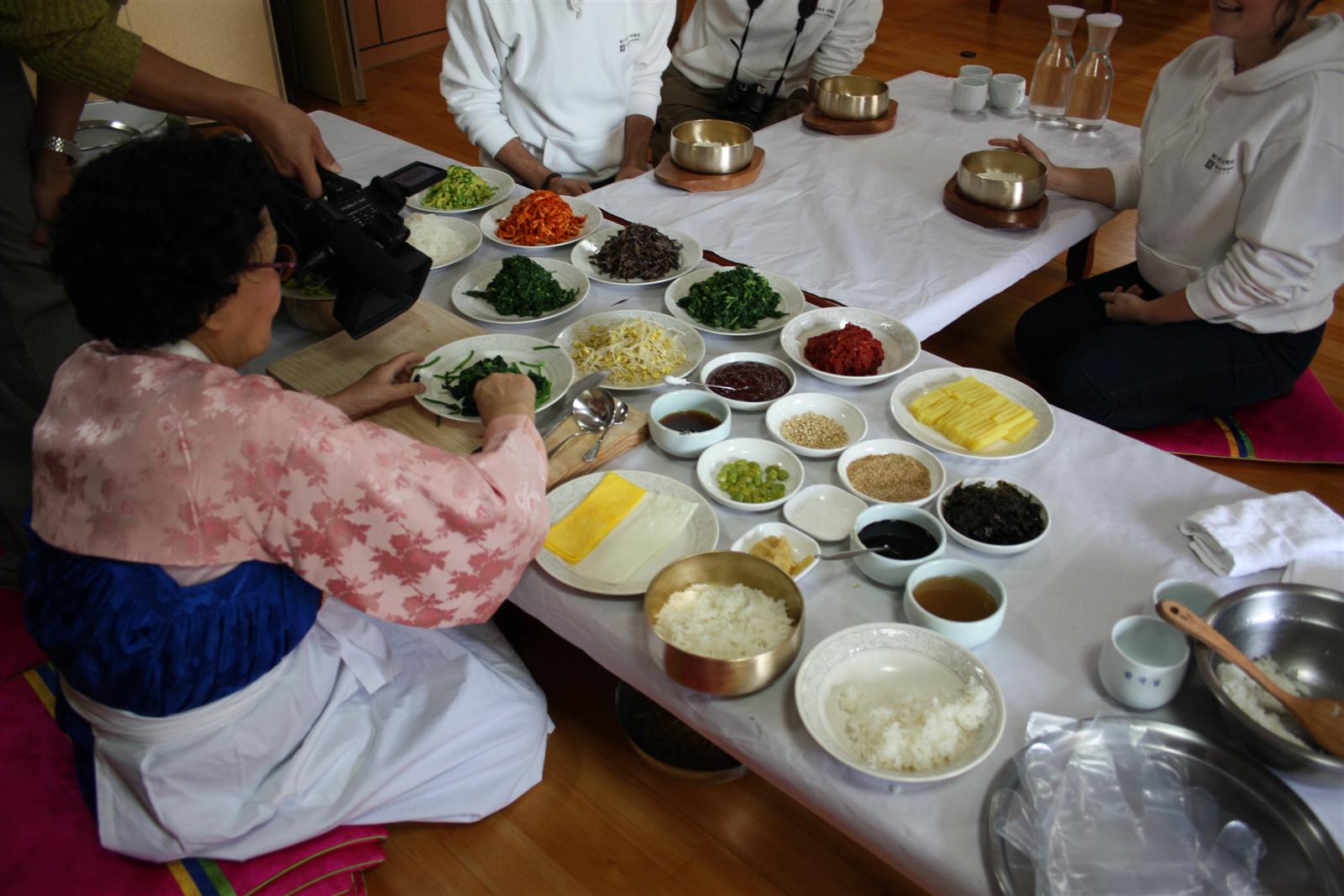
In the town of Jeonju, however, bibimbap became something royal. At the Korea House restaurant in Jeonju during the first meal of our Hansik Korean Traditional Food Tour for Foreign Foodies, we met the daughter and grand-daughter of the woman who took a practical rice dish that incorporated whatever available or leftover ingredients or side dishes and made it into a timeless and beloved piece of art. As the foremost heir of this woman's legacy, her now senior daughter pridefully took me and my fellow team members through the thoughtful steps of ingredient selection, preparation and assembly. After making our way through the modern front restaurant, through the courtyard with its peaceful garden and small fish ponds, and a more ceremonial dining room, we gazed upon a vast rainbow of traditional bibimbap ingredients. Our assembly began with a gentle hand washing. So much of Korean traditional foods are hands-on dishes and bibimbap is no exception whether massaging of seasonings and ingredients or carefully laying ingredients over the top of the rice.

After first washing our hands, we were pointed to the key flavor foundations of the dish. This restaurant makes its own aged soy sauce. After being allowed a small pinky-dipped taste of the syrupy, dark liquid, all our faces changed in wonder. None of us had ever tasted a soy sauce so fine, so flavorful and full of rich umami flavor. Cheap commercial soy sauce is more like salty water than a flavor contributor. I recall foreign friends in college really craving quality soy sauce in the peak of their homesickness. But this artisinal soy sauce, along with house-made beef broth, minced garlic and fine sesame oil were key in seasoning each of the whole ingredients. I say "whole" because it is important. Whole, unprocessed ingredients are what I consider the heart of healthy eating. Chosing whole, unprocessed foods is, in my opinion, the single, most important act anyone seeking a healthy lifestyle could do. This one act automatically and positively influences a whole host of other healthy choices. But perhaps more encouraging is that bibimbap also proves that whole, quality, slow food is often supremely delicious.

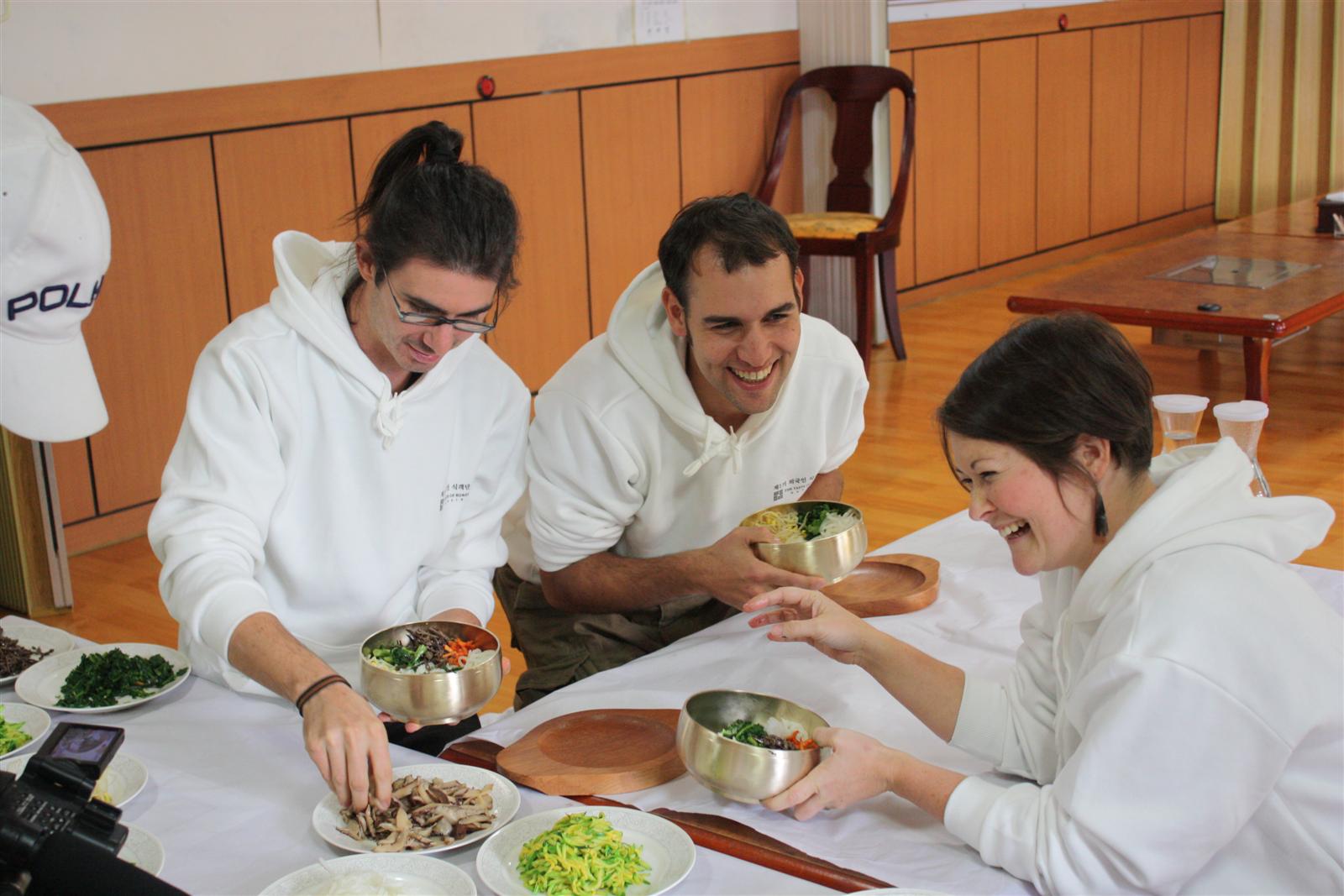
With pride, my fellow members and I got to work each crafting our own bowl of beautiful, edible art. Depending on our personal preferences, dietary needs, and creative impulses we added any of the prepared ingredients to our bowls of deliberately firm-cooked rice: spinach, bean sprouts, carrot, raw beef, fern bracken, edible chrysanthemum leaves, julienned egg white and yolk, pine nuts, sesame seeds, gingko nuts, vibrant yellow mung bean jelly, shredded dried laver, bellflower root, radish, shiitake mushroom, hot pepper paste and toasted sesame oil.

I'm not sure that any dish in Korea blends tradition and contemporary as well as bibimbap. Flanked by a delicious array of house-prepared sides, we admired this dish that had first been introduced more than 200 years ago but which now satisfies fans of Korean food all over the world. But despite its historic roots and modern fame, the dish before us was also uniquely ours. Thoroughly combined into one dynamic dish, mine bowl sung the fresh flavor of extra chrysanthemum leaves. Team-member Mike's took a vegetarian route and was fragrant with rich sesame while Greg's manifested as a hearty bowl of extra spice and beef. By its very nature, the royal Jeonju version of this dish requires human touch and by that human touch it is subject to the current whim of its maker and to the availability of fresh, quality seasonal ingredients.
I feel very blessed to have had this experience at Korea House as part of our Hansik Tour. Bibimbap was my first Korean food crush and because it doesn't have a precise recipe, it frees me to customize it to my mood and the seasons and, thus, to never tire of it. If you haven't yet tried Korean food, bibimbap might just be your "gateway drug." Once you get a sense of Korean's simple approach to big, bold and sexy flavors, you might just join the world of fans in our love for this dish that never gets old.

Our teacher and daughter of the royal version creator shows us ingredient preparation.

Slow food is community building-- it is real experiences and memory-making. :)

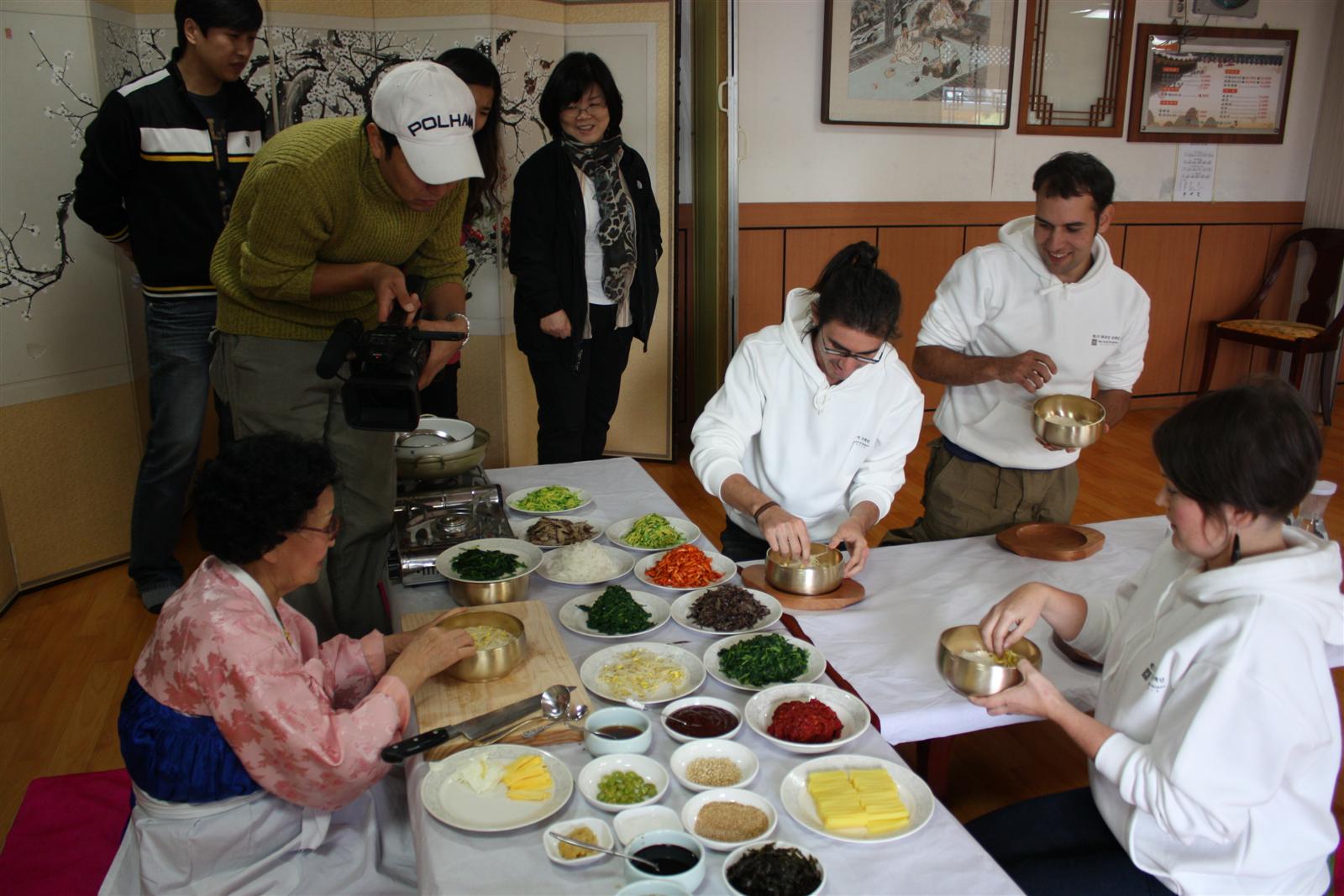
Assembly begins while our production crew looks on.

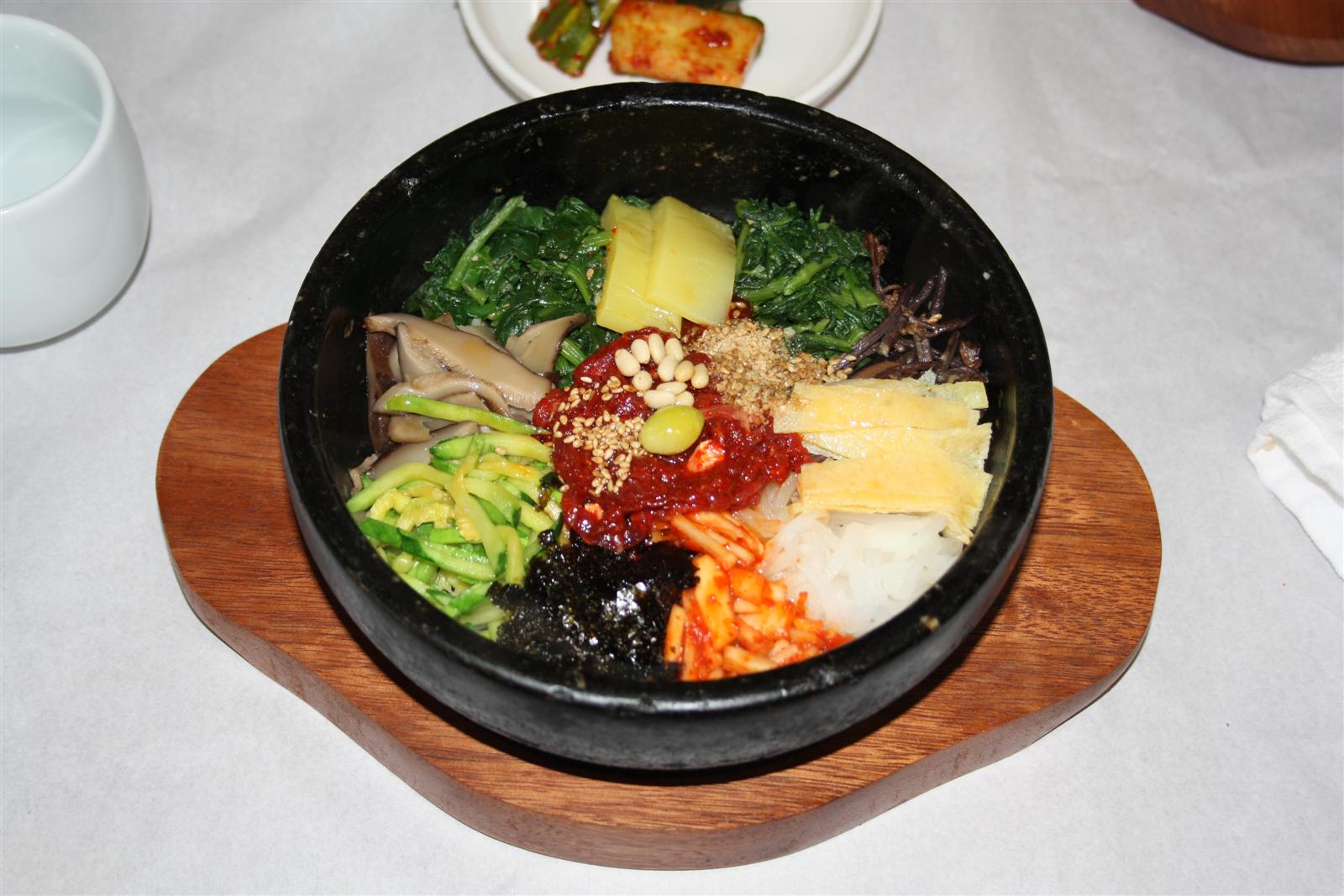
Korea House provided us with a tasty display of the hot-pot version (which we also devoured!)

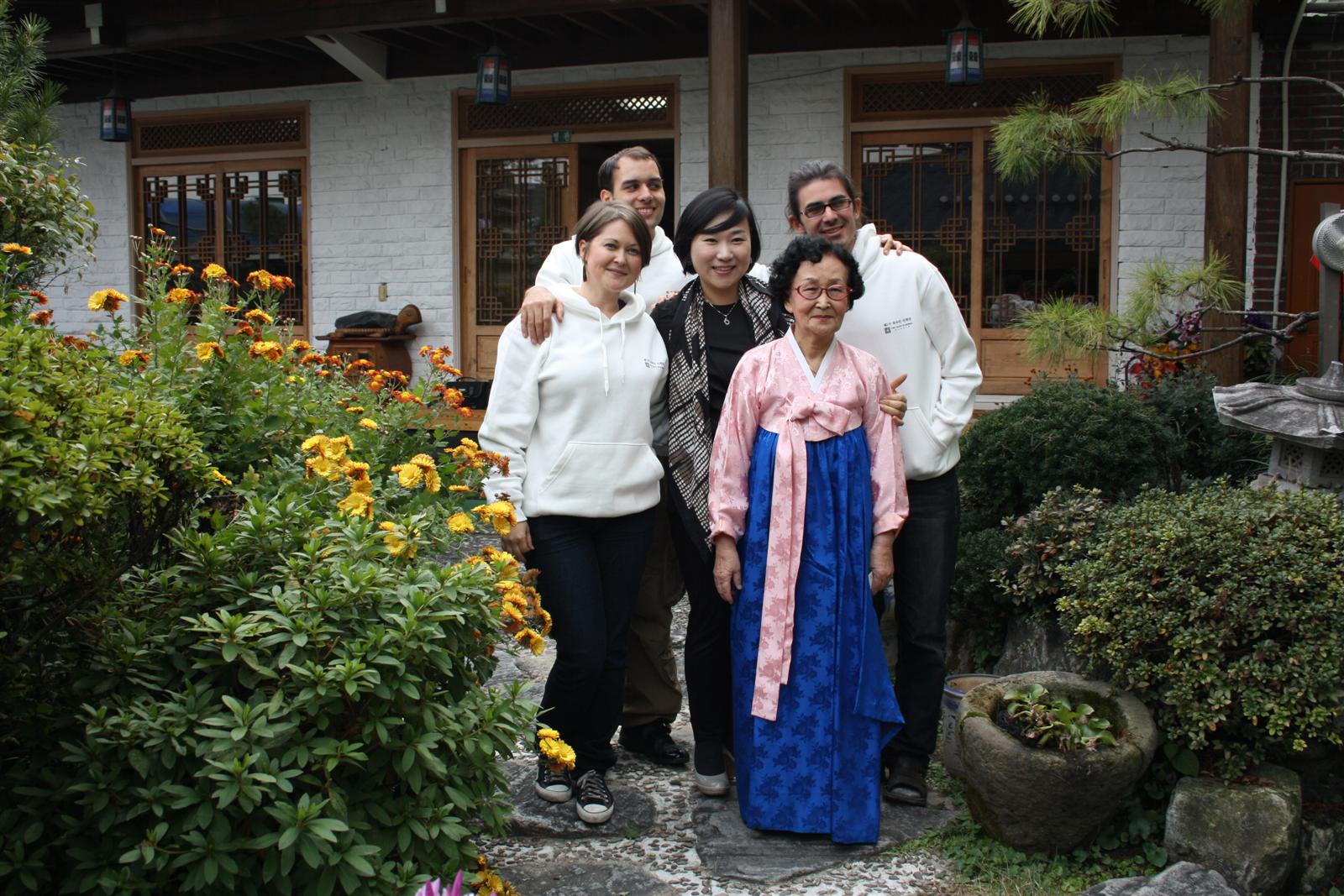
Three of our Happy Bear team members with daughter and grand-daughter of the creator.
Lovely restaurant, thank you for your hospitality!!


-Tanya

Korea House offers two choices of bimbimpap and many delicious sides with it. Please check the link in the article for directions and a map.

Wednesday, November 2, 2011

Bibimbap: Veg Heaven

Whenever I tell Koreans that I'm a veg*an, they generally ask the same question: what do you eat? Most of them don't seem to realize that Korean cuisine is full of awesome vegetarian goodies: pancakes made with green onions, chives, kimchi, potatoes, or lentils; noodles hot, cold, creamy, or spicy; all kinds of soups porridges; tofu in various guises. Then, of course, there's also 정식, or Jeongsik, or Table d'hôte, or the "set meal." No matter what you call it, it means rice, soup, and anywhere from, say, five to thirty-five side dishes, almost all of them veg-friendly.

However, the king of Korean vegetarian fare is, without question, Bibimbap (literally, mixed rice). Normally, I wouldn't take it upon myself to write about it, given that it's probably the simplest, most well-known, and most widely-diffused Korean food out there, with the possible exception of LA Kalbi. Thanks to Hansik, though, I recently underwent the most extreme and regal Bibimbap experience of my life, at Korea House in Jeonju.


Bibimbap with a master. This Granny (a term of respect in Korean) has been making Bibimbap for 52 years and claims that her mother invented it, or at least the high-class version.

Your standard Bibimbap - even the one I ate on the airplane on the way over here nearly five years ago, which, incidentally, was the first Korean food I ever tried - is vegetable heaven. Julienned vegetables like sauteed radish, carrot, and bracken, along with steamed and seasoned spinach, some bean sprouts, and a bit of roasted seaweed sit atop a bed of rice. Throw an egg on top if you'd like, drop on a dollop of red pepper paste, and stir it all up. Voila: a natural, low-maintenance, delicious vegetarian meal. At a cheap restaurant, this will run you about 3 dollars; at a fancy one, closer to 6.

For Kings, or, in this case, a bunch of vagabond foodies, Bibimbap can really be scaled up. Check out our table above: everything I just mentioned, plus sweet and spicy balloon flower root (it's OK if you have no clue what this is), sauteed zucchini, sautéed shiitake mushrooms, thin-sliced egg, mung bean jelly, ginko nuts, pine nuts, crushed sesame seeds, and a special broth made right there at the restaurant.


Some of the high-class toppings


Listening attentively to half a century of wisdom.

Being that everything will eventually get all stirred together, you'd think you could just throw in all the ingredients any which way. It's not so, though! The master insisted that we put each ingredient in its own place, paying particular attention to color symmetry. White radish slices and bean sprouts should be on opposite sides for optimal aesthetic appeal; sauces and nuts at the end to give it that just-completed look.


Me, Greg, and Tanya enjoying the lesson. Unfortunately (for them) Andy and Anina had not yet joined the festivities.


Can you believe I made that?

It turns out that even mixing it requires a particular technique. In addition to stirring everything up and mixing it evenly, one has to be sure to smush it together just so, in order that the perfect balance of soy sauce, sesame oil, and pepper paste will be mashed in to each grain of rice.


I got a little help from the boss on this one. Oh my god was it good.

It turns out, then, that Bibimbap has a fairly unique quality: no matter who puts the dish together for you, the final result is the outcome of your own skill. Even if you go all the way to Jeonju, search out the "Hangukjib," (the name of this restaurant) and order the most deluxe bibimbap on the menu, it's up to you to make it or break it! I see a little something symbolic in this: money can't buy you the best bibimbap; only familiarity can. Good food calls for good cooks, but also for good eaters, eaters who know something about the story and the theory of their food. Eating is consumptive, of course, but at its best, it's also participatory. More than many other places I've been, Koreans seem to be intent on holding on to this respectful, if not quite reciprocal, relationship between eater and eaten. Not as much as they should, given how many treasures their cuisine contains, but enough that just living and eating here as made me aware that people can, in fact, approach their food in different ways, some better than others. I owe many thanks to this Grandma in particular, and to others like her all around the country, for helping me learn how to really enjoy and appreciate food. Now, go get a bowl for yourself.


Me, Tanya, and Greg with two generations of Bibimbap Matriarchs.